
En
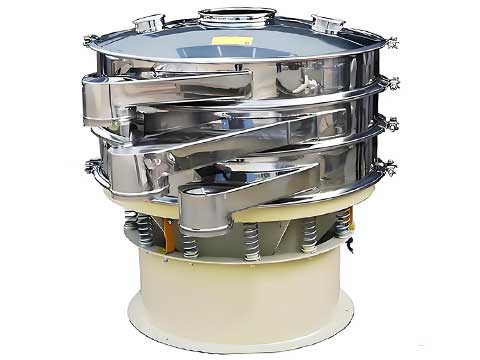
Feed Size: 10-500 mesh
Capacity: 0.1-5 t/h
Application Scope: chemical, food, pharmaceutical, mineral screening, metal waste recycling.
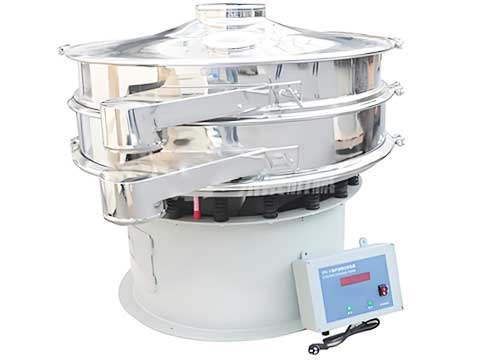
Rotary vibrating screen is a high-precision vibro sifter that integrates impurity removal, classification, and filtration. Sometimes it is also called a rotary vibro sifter or a three-dimensional rotary vibrating sieve.
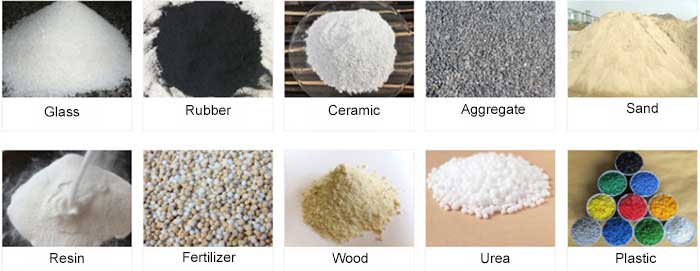
Rotary vibrating screens can meet various screening needs for powders, granules and liquid filtration needs. They can easily screen dry, wet, fine, coarse powders and granules with different specific gravities ranging from 0-500 mesh, the rotary vibraing sieve can also filter slurry materials ranging from 0-600 mesh easily. Rotary vibrating screen can be used in single or multiple layers simultaneously, with a maximum of 5 layers.
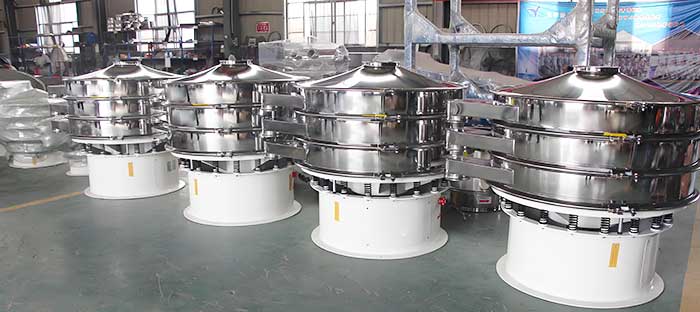
Particle Size Classification: Such as quartz sand screening (classification of 40-70 mesh and 70-140 mesh), the classification of various ores such as iron ore and copper ore, increasing the ore utilization rate by about 8%.
Impurity Removal and Filtration: Removing lumps in medicinal powder or foreign objects in food raw materials. Its sealing structure can effectively prevent dust pollution and meets food hygiene standards.
Slurry Solid-Liquid Separation: Suitable for viscous materials such as coatings and ceramic glazes, it can adapt to the processing requirements of materials with different viscosities.
Rotary vibrating screen adopts a vertical vibration motor as the vibration source. The eccentric weights at the upper and lower ends of the vibration motor convert rotational motion into horizontal, vertical, and inclined three-dimensional motion, which is transmitted to the screen surface of the rotary vibrating screen.
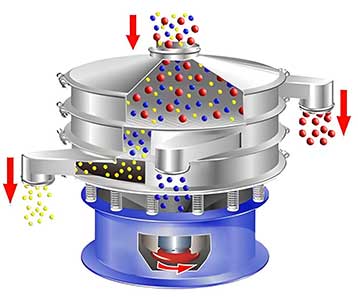
Materials enter the rotary vibrating screen through the feed inlet. According to different screening requirements, the materials are stratified and screened through 1-5 layers of screen meshes with different aperture diameters.
During screening process, the cleaning devices under the screen meshes of each layer continuously impact the screen meshes to promote the rapid completion of material screening. Materials with a particle size smaller than the sieve aperture become undersize materials, while materials with a particle size larger than the sieve aperture are discharged from the outlet of that layer as oversize materials, thus achieving the purpose of screening or filtering.
1. A bounce cleaning device is installed under the screen mesh of each layer.
2. Impurities and coarse materials are discharged automatically, output up to 5 t/h.
3. Fully sealed structure, no powder overflow, no liquid overflow.
4. The discharge outlet can rotate 360 °, and replacing screen easily within 5 minutes.
5. Customizable 1-5 layer multi-layer screening, which can finally obtain 2-6 types of finished products with different specifications.
Q1: What Are the Common Vibro Sifter Mesh Sizes?
Coarse Screening: 20 mesh (0.85 mm), 30 mesh (0.60 mm), 40 mesh (0.45 mm), 50 mesh (0.37 mm);
Medium-Fine Screening: 60 mesh (0.30 mm), 80 mesh (0.20 mm), 100 mesh (0.15 mm), 120 mesh (0.125 mm), 150 mesh (0.10 mm);
Fine Screening: 200 mesh (0.08 mm), 250 mesh (0.065 mm), 300 mesh (0.05 mm), 400 mesh (0.037 mm), 500 mesh (0.025 mm).
Q2: Why Can’t My Rotary Vibrating Screen Meet Designed Capacity?
Reasons:
Solutions:
| Model | Screening Diameter(mm) | Screening Area(m²) | Sieve Hole (mesh) | Layer(s) | Motor Power(kw) | Capacity(kg/h) |
| XZ-600 | φ560 | 0.23 | 2-500 | 1-5 | 0.75 | 100-450 |
| XZ-800 | φ760 | 0.42 | 1.1 | 300-750 | ||
| XZ-1000 | φ930 | 0.64 | 1.5 | 400-1100 | ||
| XZ-1200 | φ1130 | 0.95 | 1.5 | 600-1600 | ||
| XZ-1500 | φ1430 | 1.61 | 2.2 | 800-1800 | ||
| XZ-2000 | φ1920 | 2.9 | 3.0 | 1300-2500 |
Notice: There is a chance that LDHB may make changes to above-mentioned information. Please feel free to contact us for the latest product information.