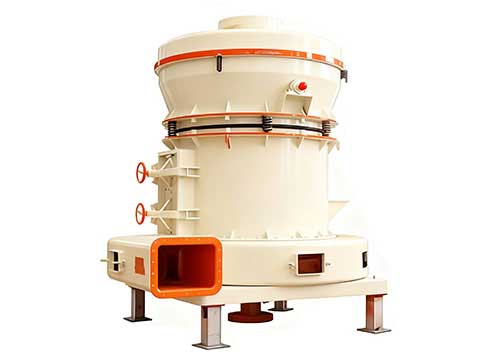
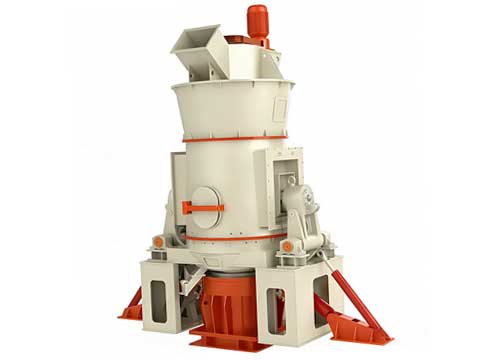
Raymond mill and vertical roller mill are common industrial grinding equipment, but it’s unclear whether to choose a Raymond mill or a vertical roller mill. The following provides a comprehensive comparative analysis of the differences between the two, helping users select the most suitable vertical grinding mill.
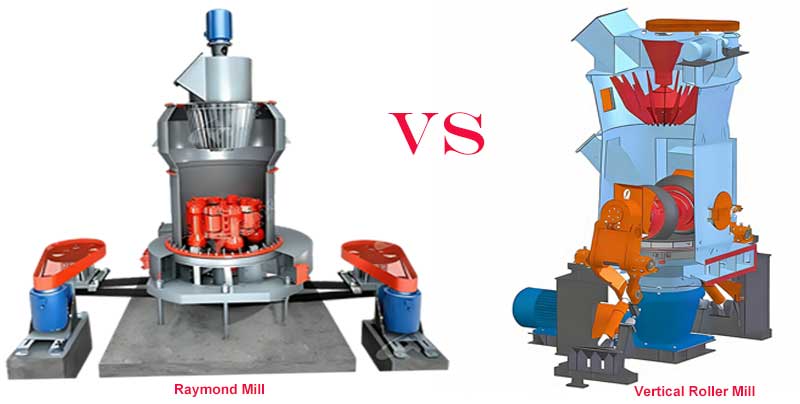
1. Structural Differences
| Type |
Raymond Mill |
Vertical Roller Mill |
| Grinding Roller |
Fewer grinding rollers (5-6);
Hanging on a spring plum blossom rack;
Make circular motion around the central axis. |
Multiple grinding rollers (up to 36);
Horizontal layout and fixed position;
Connected to the grinding disc through a lever bracket. |
| Grinding Ring |
The grinding ring is fixed and serves as a side wall to form a grinding zone with the grinding roller. |
The bottom grinding disc rotates and uses centrifugal force to evenly distribute the material to the edge of the grinding disc. |
| Transmission System |
The material is lifted by the bottom shovel and sent between the grinding roller and the grinding ring for squeezing and grinding. |
The grinding roller rotates on its own without direct contact with the rotating grinding disc, and pressure is applied through a hydraulic system to crush the material. |
| Maintenance |
It is necessary to open the host casing to replace the grinding roller or ring, which is a tedious maintenance task. |
The grinding roller can be flipped out of the main engine chamber through a lever bracket, making it easy to quickly replace the roller sleeve and lining plate. |
2. Appearance Differences
Similarities: Both Raymond mill and vertical roller mill are in an upright position, with a compact main structure.
| Type |
Raymond Mill |
Vertical Roller Mill |
| Grinding Roller Angle |
The grinding roller surface of Raymond mill is almost perpendicular to the ground |
The grinding roller surface of the vertical mill is at a horizontal angle to the ground |
| Integration |
Raymond mill has a relatively simple structure |
The vertical mill has a complex structure and is usually equipped with complex components such as separators and hydraulic devices. |
3. Working Principle Differences
| Type |
Raymond Mill |
Vertical Roller Mill |
| Grinding Method |
The material is crushed through extrusion and grinding between the grinding rollers and the fixed grinding ring. |
The material is ground and crushed under pressure between the grinding rollers and the rotating grinding disc, forming a stable material bed. |
| Classification System |
Fine powder is transported by airflow generated by a fan to an analyzer for classification. Qualified particles are collected, while coarse powder is returned to the grinding chamber for re-grinding. |
Equipped with a high-efficiency separator, fine powder is carried away by airflow, while coarse powder is returned to the grinding disc for further grinding. |
| Energy Cost |
Low grinding efficiency and high energy consumption. Some models require additional drying equipment. |
High crushing efficiency, low energy consumption, some models come with a drying system that can process materials with a moisture content of ≤ 15%. |
4. Application Differences
| Type |
Raymond Mill |
Vertical Roller Mill |
| Applicable Materials |
materials with lower hardness, such as limestone, gypsum, calcite, etc. |
materials with high hardness and strong abrasion resistance, such as slag, cement raw materials, coal gangue, etc. |
| Fineness Range |
80-600 mesh |
The fineness can be adjusted within a large range (80-400 mesh), ultrafine vertical mill can reach 200-3000 mesh. |
| Production Capacity |
Low output (1.5-80 t/h), suitable for small and medium-sized production. |
High production capacity (10-170 t/h), suitable for large-scale production. |
| Industry Applications |
In the fields of building materials, metallurgy, chemical engineering, refractory materials, etc., traditional crafts have a large market share. |
cement, non-metallic minerals, electricity, metallurgy and other fields, especially suitable for the production of high value-added products (such as high-end boards, coatings, pharmaceutical grade calcium carbonate). |
5. Price Differences
| Type |
Raymond Mill |
Vertical Roller Mill |
| Small |
$7k-15k |
$20k-40k |
| Medium |
$15k-30k |
$40k-90k |
| Large |
$30k-70k |
$90k-200k |
Warm Tip
If the production scale is small, the budget is limited, and the material hardness is low (such as limestone, gypsum), Raymond mill is the cost-effective choice.
If large-scale production and high fineness products (such as ultrafine calcium carbonate) are required, or materials with higher hardness (such as slag and cement raw materials) need to be processed, vertical roller mills are more suitable.