
En
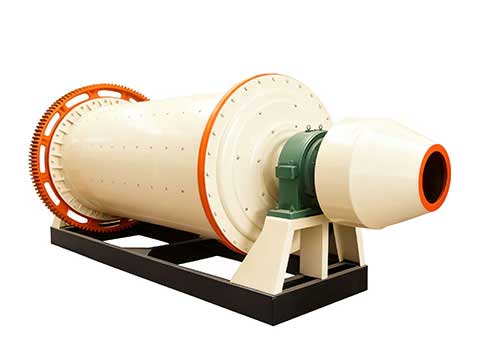
Ball mill machine is a key equipment for further pulverizing materials after they have been crushed, and is currently the most commonly used grinding machine in mineral processing plants. According to different ore discharge methods, ball mills can be divided into grid ball mills and overflow ball mills. So what is the comparison between these two types?
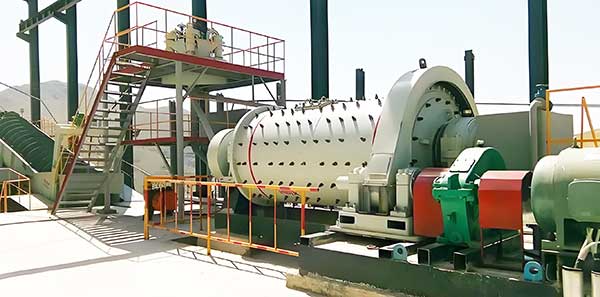
Both types of ball mills have essentially the same structure, mainly consisting of a cylindrical section, ore feeding section, ore discharge section, bearing section, transmission section, and lubrication system.
When working, the ore feeding unit sends ore into the ball mill cylinder, which then rotates at a specified speed around a horizontal axis. Meanwhile, the ore moves in a free-falling or (projectile-falling) motion due to centrifugal force and the frictional force of the grinding media, undergoing impact and grinding to be pulverized. The ground products are then discharged through the ore discharge port.
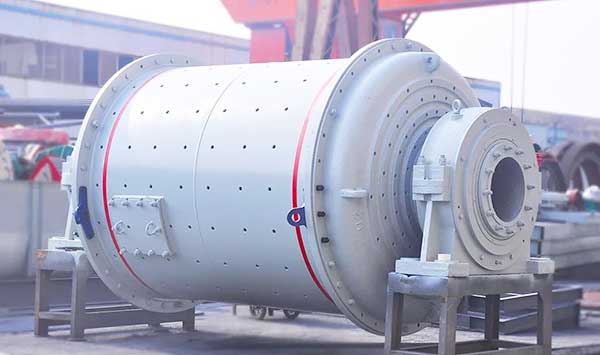
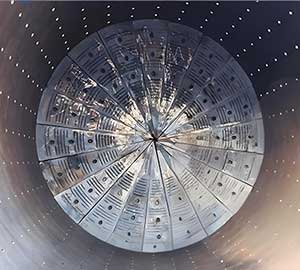
Grid Ball Mill: A grate lining is installed on the ore discharge side, with an additional grate plate at the outlet end. The grate plate has numerous 7-20mm discharge holes. After being ground in the ball mill, the material passes through the grate plate.
On the side of the grate plate near the ore discharge end, there is a pulp lifting device consisting of radial ribs that divide the space between the grate plate and the end cover into several fan-shaped chambers leading to the hollow shaft neck.
When the ball mill rotates, the radial ribs lift the pulp discharged through the small holes in the grate plate to the hollow shaft neck for ore discharge, which is then expelled from the ball mill through the hollow shaft neck.
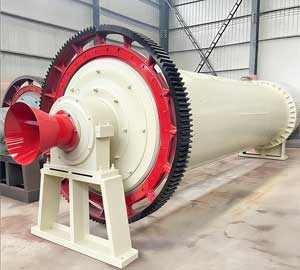
Overflow Ball Mill: No grate lining is installed on the ore discharge side. Instead, the inner surface of the hollow shaft neck bushing at the ore discharge end is equipped with spiral blades whose direction is opposite to the rotation direction of the mill. These blades return small steel balls and oversized coarse particles overflowing from the pulp back into the ball mill.
The ore discharge in an overflow ball mill relies on the pulp overflowing when its level exceeds the lower edge of the hollow shaft neck bushing.
Grid Ball Mill: The upper limit of the particle size of the grinding product from a grid ball mill is generally 0.2-0.3mm. Therefore, it is commonly used in the first stage of grinding and often forms a closed-circuit with a spiral classifier.
Overflow Ball Mill: The particle size of the grinding product from an overflow ball mill is generally less than 0.2mm, making it suitable for regrinding operations of concentrates to obtain finer qualified products. The selection of an overflow ball mill is mainly based on the material throughput. In large-scale mineral processing plants (processing materials larger than ф4000mm), an overflow ball mill is often chosen to form a grinding circuit with a cyclone.
Grid ball mill discharges materials through a screen plate. Its unique grate plate and lifting buckets within the fan-shaped chambers enablel forced ore discharge. The finely ground ore particles do not remain in the ball mill for long and are promptly discharged, reducing the occurrence of excessive grinding of materials.
Overflow ball mill allows materials to overflow automatically. When the material level rises above the discharge port, automatic discharge occurs. However, the discharge rate is slow, and the ore remains in the machine for an extended period, leading to severe over-grinding.
Grid ball mills are mainly used for coarse and primary grinding of metal ores such as iron ore, copper ore, and gold ore, as well as certain non-metallic ores like phosphate rock and limestone.
Overflow ball mills are widely used in ore processing requiring fine grinding, such as precious metal ores like gold and silver ores. They can also be used in the closed-circuit grinding system of mineral processing plants for regrinding processes to improve concentrate grades.
The main characteristic of a grid ball mill is forced ore discharge. The low pulp level at the ore discharge port allows the finely ground particles to be discharged promptly, preventing the concentration of heavier minerals inside the ball mill. Grid ball mills are often placed in the first stage of grinding operations and can achieve high processing capacities.
Typically, the production rate of a grid ball mill is 10%-25% higher than that of an overflow ball mill.
Inside a grid ball mill, there are steel balls of various sizes. When the steel balls are lifted to a certain height and then fall back, they have a relatively large falling height due to the lower pulp level, resulting in strong impact forces on the materials and significant crushing effects, leading to better grinding results.
When the material particle size needs to be ground to a uniform product of 48-65 mesh, a grid ball mill is a better choice.
The ore discharge structure of grid ball mill makes it prone to clogging the grid plate during operation, resulting in complex maintenance procedures.
Usually grid plate requires replacement every 3-6 months, leading to a short maintenance cycle and an increase maintenance costs by 30%-50% annual .
Overflow ball mill features a simple structure and is easy to maintain. Its main wear part is the cylindrical liner, which requires replacement every 6-10 months. This results in a longer maintenance cycle, lower costs, and a 40% reduction in failure rate.