
En
Stirred mill, as a new type of fine grinding equipment, its extensive application makes it possible for mineral processing that require finer grinding. In the process of fine and ultra-fine grinding, the stirred mill fully demonstrates its advantages of high efficiency and energy saving, and has been gradually recognized and accepted.
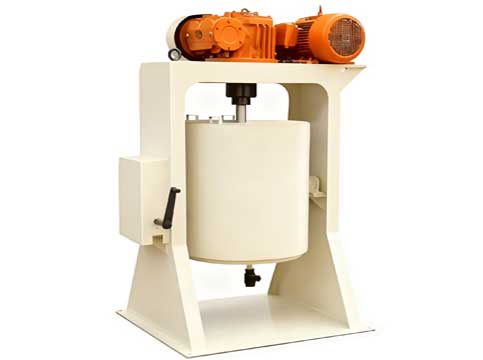
Stirred mill itself is a type of mill with grinding media, which is generally referred to as “agitator mill“.
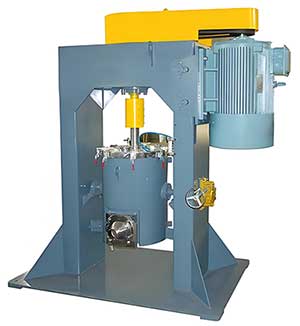
A stirred mill mainly consist of a stirring device, frame, cylinder, and transmission device. Its principle is to use the stirring shaft to complete rotation and lifting, stirring the filled mineral media in the cylinder, promoting internal self-rotation and circulation movement.
Various grinding materials in the stirred mill will be subjected to impact effects such as extrusion, shear, and grinding, and finally complete the beneficiation process through irregular mutual impact.
Batch stirred mill equipped with a circulation discharge device, it not only ensures the circulation and mixing of materials during grinding but also guarantees timely product discharge.
Batch stirred mills are mainly used in industries such as fine ceramics, electronic materials, and powder metallurgy. When equipped with large-volume circulation tanks and multiple stirred mills in series, they can be used for circulation grinding and continuous grinding respectively.
Circulation stirred mill usually adopts a disc-type stirrer, and the residence time of materials in the cylinder is controlled by adjusting the feed rate. The slower the feed rate, the longer the residence time, and the finer the product particle size; conversely, the coarser the product particle size.
Circulation stirred mill has high grinding efficiency, and the circulation tank also has mixing and dispersion functions, making it energy-saving and highly efficient. In mineral processing, the circulating stirring mill is used for ultrafine grinding of various metal minerals (such as hematite, pyrite, magnetite, etc.) and gangue minerals.
Continuous stirred mill’s cylinder diameter is small, the circulation tank volume is large, and a filter screen is installed at the upper part of the cylinder. During grinding, the material circulates at high speed between the cylinder and the circulation tank until the qualified
Continuous stirred mills enable continuous feeding, grinding, and discharging of materials, making them suitable for large-scale, high-efficiency operations.
In addition to wet-type models, there are also dry-type models. Its structure is basically the same as that of wet-type mills, except that a cyclone separator replaces the hydraulic classifier, and a blower replaces the slurry pump.
The features of tower mills are: medium-low speed, high media filling height, and high energy utilization rate. However, the cylinder is too tall, making maintenance and repair somewhat inconvenient.
The features of annular gap stirred mill is that it uses a conical body to form a gap-type grinding area, solving the problem of uneven energy density. It has high energy density, fine and evenly distributed product particle size.
However, the effective volume of annular gap stirred mill is small, and equipment large-scale is difficult, limiting its application to only some precision ceramics, abrasives, and special inks and coatings in finishing industries.
In practical mineral benefication applications, some mining areas have achieved concentrate iron content below 38.05% and particle size distribution where -0.074 mm particles constitute 70% of the total.
Primary metal ores processed by stirred mills include hematite, pyrite, wolframite, limonite, and magnetite. Associated gangue minerals encompass garnet, quartz, fluorite, amphibole, along with minor amounts of clay, mica, and pyroxene.