
Position:

Shaking Table vs Spiral Chute

Date:2026-04-16
View: 8 Point

1. Different Working Principles

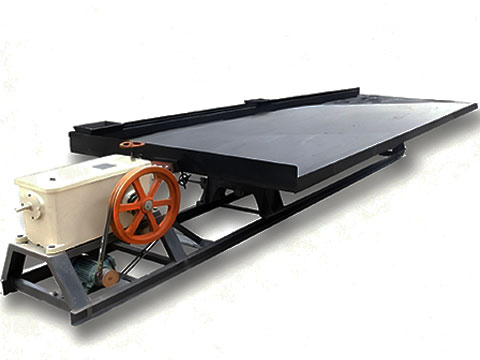
Shaking table achieves separation through the reciprocating motion of the table surface and transverse water flow. When pulp flows on the inclined shaking table surface, heavy minerals move longitudinally along the table due to high inertia, while light minerals are washed away transversely by water flow, resulting in final separation.

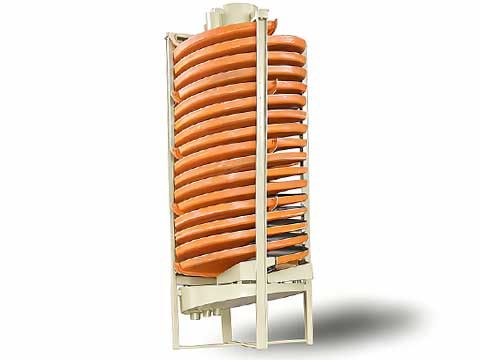
Spiral chute relies on the combined action of gravity, centrifugal force and water flow. After pulp enters from the top of the spiral trough, it flows downward along the spiral track. Heavy minerals move toward the outer side due to high centrifugal force, while light minerals concentrate near the inner side, thus realizing separation.
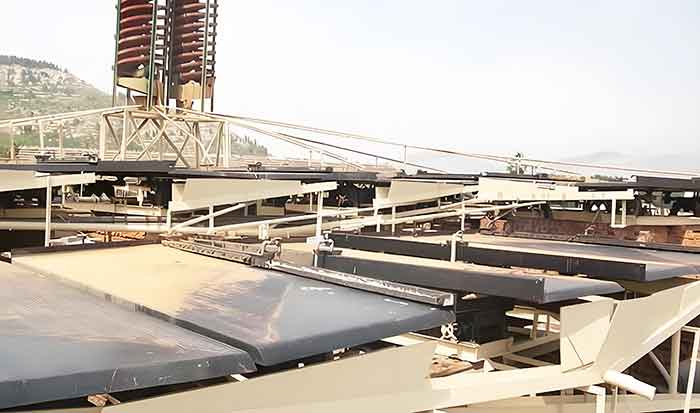
shaking table beneficiation

2. Different Processing Abilities

Shaking table is suitable for processing fine materials with a particle size of 0.037–3 mm, and performs especially well for minerals with large density differences such as gold, tungsten and tin, but its processing capacity is relatively low.

Spiral chutes are suitable for processing materials with a particle size range of 0.02–0.3 mm. They perform excellently in processing iron ore, titanium ore and manganese ore, are commonly used for the preliminary concentration of minerals, and feature a relatively high processing capacity.

3. Different Outputs

A single shaking table has a processing capacity of approximately 0.5–2 t/h and produces high-grade concentrate.

A spiral chute has a processing capacity of up to 3–10 t/h, making it suitable for large‑scale roughing operations.

4. Parameter Comparison

Item Shaking Table Spiral Chute
Working Principle Asymmetric reciprocating motion+
cross water flow, stratified by density
Gravity + centrifugal force;
heavy minerals concentrate inward during spiral flow
Effective Size Range 0.037-3mm 0.02-0.3mm
Single Unit Capacity 0.5–2 t/h 3–10 t/h
Enrichment Ratio High (10–50 times) Medium (5–12 times)
Separation Accuracy Extremely high Medium, with more gangue inclusions
Energy Consumption Motor-driven, high energy consumption No power, 0 energy consumption
Floor Space Large (4–8 ㎡ per unit) Small (1–2 ㎡ per start, stackable in multiple layers)
Water Consumption High (needs plenty of washing water) Low (about 60% less water than shaking table)
Application Purification of rough concentrate to produce
final concentrate
Concentration of raw ore, tailings discarding,
and volume reduction
Core Advantages The highest separation accuracy;
can produce multiple products
simultaneously with high enrichment ratio
Simple structure, lowest cost,
large processing capacity, no power required
Main Disadvantages Large floor space;
low processing capacity per unit area;
requires skilled operators
Low recovery rate, low enrichment ratio;
requires intermittent cleaning;
poor operating environment

Summary:

In actual mineral processing, the core logic of equipment combination is roughing for tailings discarding → cleaning for grade improvement → scavenging for recovery. Through complementing different equipment in terms of particle size, processing capacity and enrichment ratio, a balance of high recovery rate + high grade + low cost is achieved. The following are the mainstream combination schemes in the gold mineral processing industry:
Scheme Applicable Particles Recovery Rate Gold Concentrate Grade Capacity (t/h)
Sluice Box + Shaking Table Coarse Gold 85-90% >500 g/t 1-3
Spiral Chute + Shaking Table Medium & Fine Gold 88-92% >600 g/t 3-8
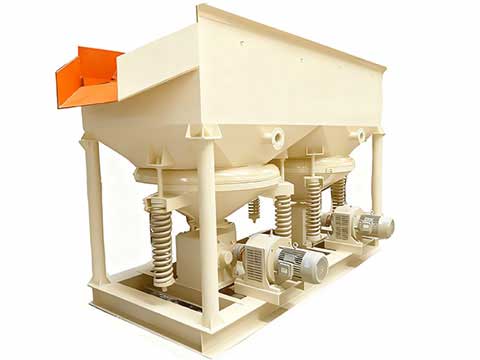
Jig + Shaking Table Coarse & Medium Gold 90-93% >700 g/t 5-15
Centrifugal Concentrator + Shaking Table Fine / Ultra-fine Gold 92-95% >800 g/t 1-5
If you have any questions, feedback or comments. Please feel free to give your inquiry. We will reply you in 24 hours.

Inquiry

If you have any question, please click here for live help. If you have any question, please click here for live help.
WhatsApp