
En
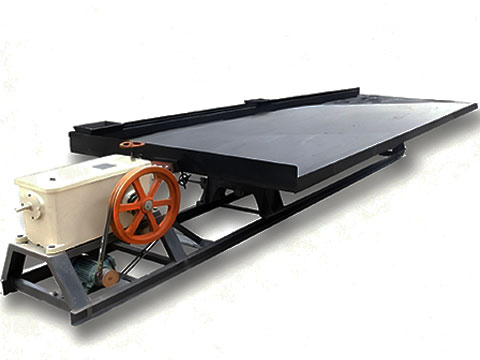
Placer gold shaking tables are one of the main pieces of equipment in gravity separation. They are widely used for the separation of tungsten, tin, tantalum, niobium, gold, and other rare and precious metal ores. Placer gold shaking tables can be applied in roughing, cleaning, scavenging and other operations, for processing different size classes such as coarse sand (2–0.5 mm), fine sand (0.5–0.074 mm), and slime (−0.074 mm).
Placer gold shaking tables can also be used for the separation of iron, manganese ores and coal. When processing tungsten, tin and other ores, the effective recovery particle size range of the shaking table is 2–0.22 mm.
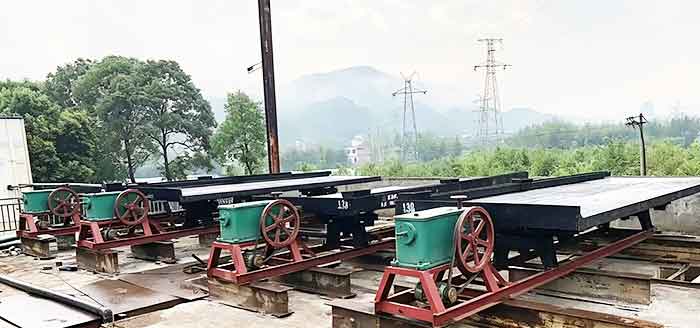
A placer gold shaking table is a piece of gravity separating equipment that separates fine‑grained minerals using the reciprocating asymmetric motion of the table surface combined with water flushing. It mainly relies on mechanical movement and cross water flow to achieve mineral separation.
During the placer gold separation process, mineral particles enter the table surface with water flow and move under the combined action of mechanical force and hydraulic action. The table surface is designed with an inclination angle of 0–10° and a length of 1–5.5 m to accommodate mineral particles of different specific gravity and sizes.
During operation, heavier particles sink to the bottom of the shaking table surface, while lighter particles rise to the top. In addition, fine particles are carried away by water flushing, thus achieving effective mineral separation.
To achieve higher separation efficiency, shaking table beneficiation equipment is usually equipped with auxiliary devices such as feeding machines and tailings recycling systems.
①. Placer gold deposits are usually classified into 3 grades, corresponding to 3 types of shaking table bed.
②. Select shaking table according to the placer gold production capacity.