
En
In a sand making production line, hoppers are vital components that perform material transfer, buffering and flow regulation. They must ensure continuous, uniform and smooth feeding during operation while maximizing storage volume and preventing dead material accumulation.
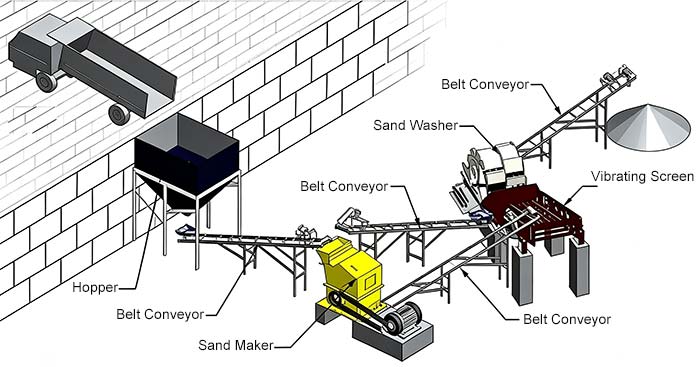
Hoppers used in sand making production lines mainly include raw material hoppers, surge hoppers and finished product hoppers.
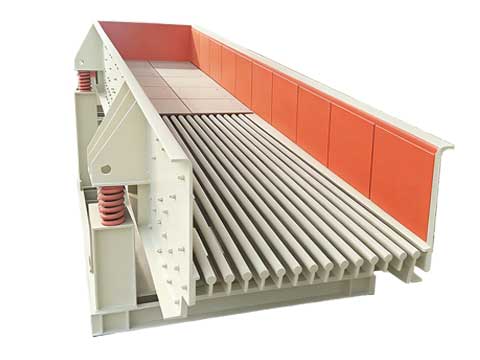
Raw Material Hoppers: Raw material hoppers are generally square-pyramid shaped, fully enclosed and fabricated by welded steel plates. They are installed upstream of vibrating feeders. Their dimensions are designed according to the processing capacity of the primary crusher as well as the viscosity and moisture of raw materials, and most of them are built above ground.
Surge Hoppers: Surge hoppers are generally made of steel frame structure or reinforced concrete pouring, located after the first stage crusher and before the second or third stage crusher, playing a role in intermediate adjustment, which can achieve uniform and stable feeding, improve the production efficiency of the crushing production line, and increase the service life of the crushing production line.
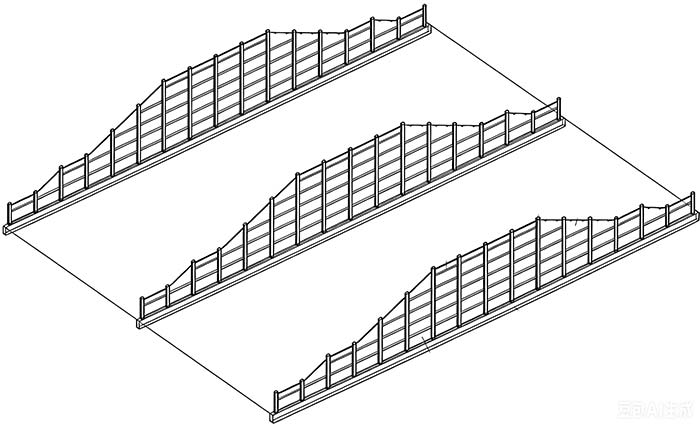
Finished Product Hoppers: Finished product hoppers are mostly rectangular factory buildings, separated into different product rooms by partition walls to achieve the purpose of graded products.
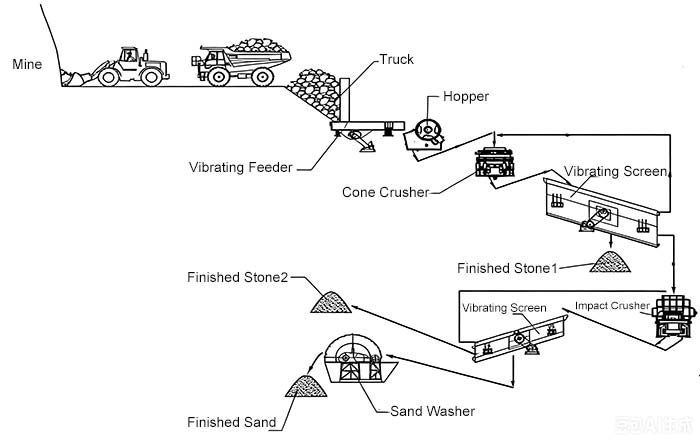
Two feeding methods, elevated platform feeding and underground pit feeding, can be selected for the feeding unit based on site conditions and raw material proportions.
The elevated platform feeding utilizes the height difference to provide gravitational potential energy to the raw materials, facilitating the entry of large stones and the early separation of natural sand. However, it is necessary to use the terrain to form a high feeding platform to facilitate the entry of raw materials.
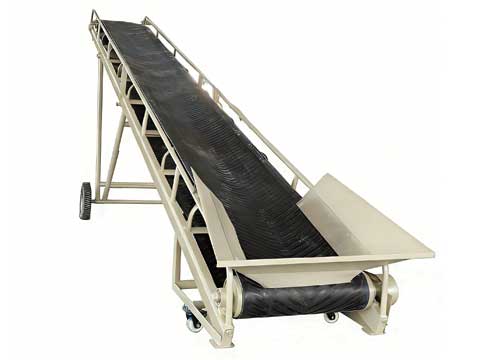
Underground pit feeding involves excavating ground pits, and conveyors transport raw materials dumped into the pits to the processing plant. This solution features lower investment and easier construction, yet it cannot handle oversized rocks.
For production lines with large changes in the composition of raw materials such as river pebbles, it is necessary to set up a surge hopper before the intermediate crushing stage to buffer the sudden increase in load or sudden idling of the crushing equipment caused by a batch of raw materials containing too much sand or too much pebbles, ensuring smooth operation of the equipment.
Finished product hoppers are mostly rectangular workshops divided into separate compartments by partition walls. High reinforced concrete retaining walls are recommended for the partitions. Finished aggregates are delivered to corresponding compartments via belt conveyors and stacked directly against the walls, greatly boosting the storage capacity of the finished product warehouse.